
Distance is a fundamental concept in Self-Defense.
Since we're taking a holistic approach, we need to consider distance from all angles.
- to be/keep the unwanted event at a distance, but not only.
- to bridge the distance to the things I desire.
In other words, to control the distance at which I wish to be.
There are factors that I can control to some extent, but there are also external factors to which all I can do (now) is limit exposure.
Time is another fundamental universal concept that we will discuss in a dedicated post, which interacts with Distance, but not only. Think about the passage of time and its impact on Health or Finances. It can work for me or against me.
A wise man and a fulfilled martial artist confessed to me that the real struggle he is facing now, in maturity, is with... diabetes, extra pounds, with regaining Health.
In all these situations, if I anticipate, I can act preventively and even turn the situation into a desired one (positive event).
To understand all these things, I need quality information and to see education as a continuous process, which never stops.
Essentially, this site is about Education, about knowledge and openness, about having access to the best information to use in making the best decisions for yourself.
You know best what is good for you!
The desired or undesired event can occur in any of the pillars we've discussed in previous articles:
1. Health (Wellbeing): Keeping illnesses at bay, depending on the stage, can mean prevention, treatment, or limiting the consequences. It might involve exploring practices like Qigong (the art of prolonging life). I recommend QITAKY school of Grand Master (Sifu 2) Adrian Florea.
2. Financial: Keeping financial problems and poor decisions at bay by having a financial plan. Those without a plan often become part of someone else's plan.
In this area, I aim to achieve Financial Independence within the next 10 years (having my current expenses covered by my Passive Income, money made by my money, invested consistently, diversified, and long-term).
We'll discuss this in more detail in future articles.
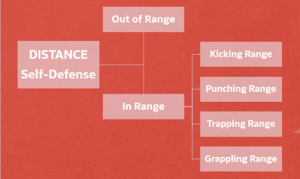
3. Physical (Aggression): In the case of physical aggression, distance means:
- A distance at which nothing can happen (Out of Range).
This is the distance where an attacker cannot reach you with their attacks. - A distance at which anything is possible (In Range)
This is the distance where an attacker can effectively engage you with their attacks.
Punching Range
Trapping / Clinching / Obstructing Range
Grappling Range
He who controls the distance, controls the fight.
Distance is fluid, it changes very quickly; I need to master transitions (the flow), to know footwork and to have a response (knowledge, techniques) in all fighting distances.
This means that the distance between you and your opponent is constantly changing and it's crucial to be able to adapt to these changes. You need to be able to move smoothly between different fighting ranges (like kicking, punching, and grappling distances) and have the necessary skills and knowledge to respond effectively in any situation.
Why is it important to know Distance?
In a dangerous situation, controlling the distance between you and your attacker is key. Ideally, you want to maintain a distance where the attacker cannot reach you. For example, if you're being threatened in your car, staying inside the vehicle is a way of controlling distance.
Distance is closely related to Context (environment) as well as other variables that I need to take into account and which I will detail in other posts:
The effectiveness of different fighting techniques is heavily influenced by your surroundings. Factors like the size of the space, the presence of obstacles, and the number of attackers can all affect your ability to control distance.
Why is it important to know Distance?
In a dangerous situation, controlling the distance between you and your attacker is key. Ideally, you want to maintain a distance where the attacker cannot reach you. For example, if you're being threatened in your car, staying inside the vehicle is a way of controlling distance.
Distance is closely related to Context (environment) as well as other variables that I need to take into account and which I will detail in other posts:
The effectiveness of different fighting techniques is heavily influenced by your surroundings. Factors like the size of the space, the presence of obstacles, and the number of attackers can all affect your ability to control distance.
- There could be one or more attackers.
- The attacker could be unarmed.
- The attacker could be armed with either a cold weapon (blunt or sharp) or a firearm
- The attacker could be standing, sitting, or lying down (which limits the number of techniques and mobility in the field).
- It could be dark or light (which can affect your ability to perceive the situation).
- It could be cold or hot outside (which can affect clothing choices and footwear).
- The ground could be dry or wet (which can affect your stability).
Reality is complex, with many unknowns and variables. It's essential to have a holistic perspective, to identify and work through possible scenarios, and most importantly, to be able to adapt solutions quickly to constantly changing situations.
These are just a few things to consider, and I hope you find the information we've provided useful and that you will apply it.