
This is not a (ring) fight, there are no rules, the attacker doesn't aim to give you a chance.
A fight in the context of sports or martial arts implies etiquette, clear rules that limit injuries, a referee who ensures they are followed, a coach who watches and can stop the fight to prevent injuries, a clear perimeter where the confrontation takes place, well-lit, at a set time, with an opponent of the same weight class, whom I might have the chance to study beforehand.
An aggressor will choose the place, time, and conditions that are favorable to him.
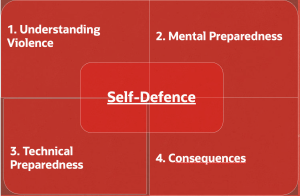
Rory Miller describes Self-Defense (the physical aggression component) as having 4 elements:
1. Understanding the Types of Violence (social/antisocial, will help you understand what can be resolved in the Pre-conflictual phase, de-escalation, response options)
2. Mental Preparation (The Mindset, "allowing yourself" to defend yourself, ethics of use)
3. Technical Preparation (training in a gym: techniques, procedures, situations, scenarios)
4. Consequences (understanding the legal, material, or moral consequences, potential psychological or other trauma)
It is very interesting and surprising that Mental Preparation is the limiting factor.
Not understanding these components and focusing solely on technical training will lead you to what Marc MacYoung defines as one or two problems that arise the moment you use your self-defense training.
”You'll have one or two problems... One, it won't work. Two, it will work. The things you don't know you don't know, will put you in the hospital, the grave, or prison.”
Another aspect is that the same technique in one context can be legally considered self-defense, while in another context it can be considered a crime and punished. This brings us to the next point: self-defense is a legal concept that has nothing to do with what we consider it to be based on personal experiences.
Self-defense is equivalent to what Romanian criminal law defines as "legitimate defense" (Article 19 of the New Penal Code, Justifying Causes). We will analyze this legal component in more detail in a dedicated post.
What is important to remember now is that there is a (legal) standard that you must understand and limits that you must stay within. The consequences of exceeding these limits fall under "Murder / Assault or injury causing death / Brawl.”